
Is the Palworld TCG Worth Investing In? (My Honest Take)
August 4, 2026
When the Palworld Trading Card Game was announced, I was all in.
I've loved the game since it’s early access launch, so I picked up booster boxes early before prices started climbing.
Around the same time, Palworld's 1.0 release reignited excitement around the game. Player sentiment was overwhelmingly positive, and the game surged back to more than 950,000 concurrent players on Steam.
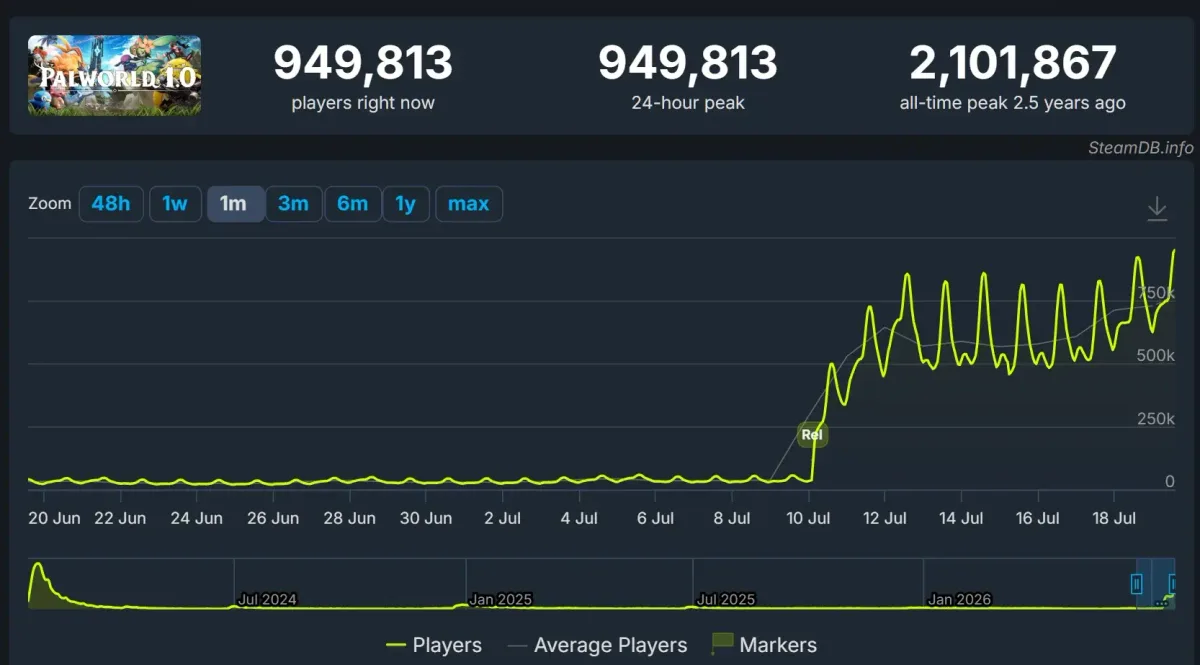
To me, it felt like proof that Palworld was more than just a viral launch. As interest in the franchise grew again, I noticed early promo cards were still inexpensive, so I picked up a few while they were still flying under the radar.
Since then, sealed product and several promotional cards have climbed significantly in price.
That got me thinking:
Is this simply launch hype, or could the Palworld TCG become a strong long-term collectible?
I don't think anyone knows the answer today. But I do think it's a fascinating question because investing in a trading card game isn't really about the cards themselves.
It's about whether you're investing in the future of an IP.
Palworld Is More Than "Pokemon With Guns"
When Palworld first launched, much of the conversation centered around the controversy.
People called it "Pokemon with guns," debated the creature designs, and questioned whether the game would fade after the initial hype, even as it reached more than 2 million concurrent players on Steam. To many, it looked like another viral game that would quickly disappear once the excitement wore off.
Then something interesting happened.
Instead of fading away, Pocketpair continued updating the game. When Version 1.0 launched, Palworld once again attracted more than 950,000 concurrent players on Steam, not including players on Xbox or PlayStation.
To me, that was one of the biggest signs that the franchise might have real staying power.
It suggested players weren't just showing up because of internet controversy, they were coming back because they genuinely enjoyed the game.
That doesn't guarantee Palworld will become a decades-long franchise, but it does strengthen the argument that the IP has real staying power.
For a trading card game, that's important.
The healthiest TCGs are supported by living franchises that continue releasing new games, attracting new fans, and giving existing fans reasons to stay engaged. Every successful update, expansion, or sequel creates another opportunity for people to discover the world—and potentially the trading card game alongside it.
A Massive Audience Is a Huge Advantage, Not a Guarantee
One of the Palworld TCG’s biggest strengths is that it isn't launching as an unknown IP.
The game has sold more copies than nearly every individual Pokemon game, introducing millions of players to its world and characters before the first booster pack even hit store shelves.
That's a tremendous head start.
But having a massive audience doesn't automatically create a successful trading card game.
Star Wars is one of the biggest entertainment franchises in the world, yet Star Wars Unlimited has struggled to establish itself as one of the hobby's dominant trading card games. A massive IP gets people to look at your game, but it doesn't guarantee they'll keep playing it. Great gameplay, organized play, consistent support, and an engaged community matter just as much.
Disney Lorcana launched with one of the strongest brands imaginable but still had to prove it could retain players after launch.
On the flip side, MetaZoo exploded in popularity despite having virtually no established entertainment IP behind it. The hype was enormous, but sustaining long-term interest without games, shows, or a broader universe proved much more difficult.
Palworld sits somewhere in between those examples.
Unlike MetaZoo, it already has millions of fans who know the creatures, the world, and the brand.
Unlike Star Wars, the audience already overlaps heavily with people who enjoy creature collecting, progression systems, and games that naturally lend themselves to trading cards.
That doesn't guarantee success, but it gives Palworld one of the strongest starting positions a new TCG could ask for.
Pocketpair's Investment in Bushiroad Matters
One of the biggest reasons I'm optimistic is Pocketpair's purchase of a stake in Bushiroad.
Bushiroad is one of the most experienced companies in the trading card industry, with successful games like Weiss Schwarz, Cardfight!! Vanguard, and Shadowverse EVOLVE.
What stands out to me is that this feels more like a long-term partnership than a simple licensing agreement. With Pocketpair taking an ownership stake, both companies have a vested interest in the trading card game's success. That gives me more confidence than if this were just a quick opportunity to capitalize on Palworld's popularity.
Of course, an investment doesn't guarantee the game will succeed, but it does suggest Pocketpair sees the TCG as an important part of building the Palworld brand rather than a short-term revenue opportunity.
Long-term support matters far more than a successful launch.
Early Reception Has Been Positive
One encouraging sign is that people who've actually played the game generally seem to enjoy it.
That's important.
Beautiful artwork might sell packs initially, but enjoyable gameplay is what creates local communities, tournaments, content creators, and players who stick around for years.
One thing that stood out to me was seeing creators like Red Zone Rogue speak so positively about the game after getting hands-on experience with it. I noticed similar reactions from other creators in the TCG community. While it's still early, the overall sentiment from people actually playing the game has been encouraging.
Every great TCG begins with one simple question:
Is the game fun enough that people want to keep playing it?
So far, I think the answer has been promising.
That said, one concern I have is how quickly sealed product has increased in price. If booster boxes become too expensive too early, fewer players may get the chance to experience the game firsthand. Long-term success depends on bringing new players into the community, and that becomes much harder if the cost of entry keeps rising.
The Opportunity Goes Beyond Cards
The trading card game shouldn't be viewed by itself.
If Pocketpair wants Palworld to become a decades-long franchise, the cards are only one piece of a much larger ecosystem.
Potential expansion could include:
Future Palworld games
Mobile games
Animated shows or movies
Comics or manga
Plushes and collectibles
Apparel
Crossovers with other franchises
Organized competitive events
Every successful entertainment franchise strengthens every other part of the brand.
Pokemon isn't just successful because of the cards. The games support the anime. The anime supports merchandise. Merchandise introduces new fans. Those fans buy cards.
The stronger the overall ecosystem becomes, the healthier the trading card game usually becomes.
What Could Hold the TCG Back?
As optimistic as I am, there are several reasons the Palworld TCG might not reach its full potential.
1. Prices May Have Risen Too Fast
One of my biggest concerns is how quickly sealed product climbed in price.
Almost immediately after release, scalpers entered the market and booster boxes became much more expensive than MSRP. That's great if you bought early, but it creates a problem for the long-term health of the game.
Every successful TCG needs a steady stream of new players opening packs, building decks, and joining local communities. When the cost of entry becomes too high too early, many potential players simply decide not to get involved.
Ironically, the biggest risk to the Palworld TCG might be its own early success.
If too much product ends up sitting in investors' closets instead of players' hands, the game could struggle to grow the active community it needs to thrive over the long term.
Healthy trading card games need both collectors and players. If the balance tips too far in one direction, it becomes much harder to build a lasting ecosystem.
2. The Local Game Store Test
Launch excitement is one thing.
The real question is what happens six months or a year from now.
Will local game stores start running weekly Palworld tournaments? Will enough players consistently show up to keep those events alive? Will players build decks, trade cards, and introduce their friends to the game?
That's the true test of any trading card game.
The strongest TCGs aren't built on release-week sales alone. They're built on communities that gather every week to play. Those local scenes create rivalries, friendships, content creators, and long-term demand for future sets.
Right now, it's simply too early to know if Palworld will reach that point.
The game has shown plenty of promise, but we'll have to see whether it develops the kind of grassroots community that keeps players coming back long after the initial excitement wears off.
3. Bushiroad Has to Find the Right Print Balance
One thing worth watching is how Bushiroad manages supply.
Bushiroad has generally leaned toward printing enough product to keep games accessible.
That's great for players.
But from a collector's perspective, too much supply can make cards and sealed product feel less special over time.
The challenge is finding the balance.
Players should be able to buy cards without paying inflated prices, while collectors still feel there's meaningful scarcity in the market.
That's one of the hardest balancing acts for any TCG publisher.
4. The Brand Has to Keep Growing
A successful card game can't rely on one hit video game forever.
Pokemon has remained relevant for decades because it continually introduces new generations of Pokemon, new regions, new stories, and new experiences.
Palworld will likely need to do something similar.
New games.
New Pals.
New stories.
New reasons for fans to stay invested.
If the IP keeps growing, the trading card game has a much better chance of growing alongside it.
5. The World Needs a Stronger Story
One area where I think Palworld has the most room to grow is its narrative.
The gameplay is what made millions of people fall in love with the game, but the world's biggest entertainment franchises create lifelong fans through memorable stories and characters.
Pokemon isn't just built on Pikachu, Charizard, and Mewtwo. It's built on decades of anime, movies, games, and unforgettable moments that helped players form emotional connections with those characters.
Palworld already has memorable creature designs and an interesting world, but much of its popularity today is driven by the gameplay rather than a compelling ongoing narrative.
I actually see that as one of the franchise's biggest opportunities.
If Pocketpair expands the universe through future games, an animated series, comics, novels, or other media, it could create much deeper emotional attachment to the world and its characters. That kind of connection doesn't just strengthen the brand—it also increases long-term demand for trading cards, merchandise, and future releases.
Gameplay creates the first fan.
Story creates the lifelong fan.
Pokemon and Palworld Can Both Win
One of the biggest misconceptions is that Palworld has to beat Pokemon to be considered a success.
I don't think that's true.
Despite all the comparisons, the two games offer different experiences and appeal to different players. Personally, I enjoy both. To me, Palworld feels like a more mature take on the creature-collecting genre, while Pokemon delivers an experience that has resonated with players of all ages for nearly three decades.
That's exactly why I think there's room for both.
Palworld has already shown it can build a massive audience without replacing Pokemon. Millions of people have enjoyed the game while continuing to play Pokemon, proving that success for one doesn't necessarily come at the expense of the other.
I think the same could be true for the trading card game.
Pokemon doesn't need to lose for Palworld to win.
Final Thoughts
So, is the Palworld TCG worth investing in long term?
I think it's one of the more interesting opportunities in the hobby, but not because I expect every booster box or promo card to skyrocket in value.
What excites me is the potential of the franchise itself.
Palworld has already proven it can attract a massive global audience. It wasn't just a viral launch—the game returned with incredible momentum for Version 1.0, and Pocketpair has continued investing in the IP through new content and its partnership with Bushiroad.
That doesn't guarantee the trading card game will succeed.
The TCG still needs healthy organized play, smart print decisions, continued support from local game stores, and a steady stream of new players. Pocketpair also has a tremendous opportunity to deepen the world through stronger storytelling, future games, merchandise, and other media that create lasting emotional connections with fans.
Those are the things that build collectible franchises over decades.
As someone who enjoys both Pokemon and Palworld, I don't see this as a competition. The two games offer different experiences, and I think there's room for both to succeed in the TCG space.
We'll have to see how it all plays out, but if Pocketpair continues executing well, I believe today's Palworld cards could someday be remembered as the beginning of something much bigger than a single trading card game.